How to Spot Fake One Piece Cards: 8 Checks Before You Buy
OP Compare · 5 November 2026 · 8 min read · Prices updated 7 Nov 2026 · How we research this


The short version
- Start with the back. Counterfeits get the blue, the logo and the border wrong far more often than they get the front wrong, and you can compare it with any common from the same set.
- Then the light test. A real Bandai card has a dark core: hold a phone torch behind it and almost nothing comes through. Most fakes glow.
- The cards worth checking are the expensive ones. Monkey.D.Luffy (SP · Gold) is US$13,000 on TCGplayer today, and 190 pack-pullable printings are worth US$100 or more.
- A price far under every store is the first warning, not a bargain. The table below shows the cheapest real store price for each chase card, so you know what “too cheap” means.
Counterfeit One Piece cards are a problem in direct proportion to price. Nobody fakes a common; the Manga rares, SP cards, alternate-art Leaders and Treasure Rares at the top of the market are the ones that turn up as fakes on marketplaces, in social-media sales and occasionally in a bulk lot. The checks below are the ones stores and graders use. None needs equipment beyond a phone torch and a real card to compare against, and together they catch almost every counterfeit on the market today.
The eight checks, in the order to do them
- The back. Every real One Piece card has the same back: a specific mid blue, a crisp Bandai logo, sharp small text and an even border. Put the suspect card beside a common from any set. A back that is darker, more purple, blurrier or has a different border width is a fake, whatever the front looks like. This single check catches most counterfeits.
- The light test. Hold a phone torch flat against the back and look at the front in a dark room. Bandai's card stock has a dark core layer, so very little light passes through and the card looks nearly opaque. A fake printed on plain card glows, often enough to see the art from behind.
- The holo pattern. On a real foil the pattern is fine, even and sits under the ink, so the art stays sharp as you tilt it. Fakes use a coarse rainbow foil, a pattern that runs over the text, or a “holo” that is a printed sparkle with no movement at all. Compare with a real foil of the same rarity, because each rarity has its own treatment: the rarities guide shows which cards are foil and which are not.
- Texture and thickness. Real cards have a slight texture and a firm snap; a fake is often glossier, thinner or softer, and a stack of them is noticeably shorter than a stack of real cards. If you have ten real commons, weigh them against ten suspect cards on a kitchen scale.
- The font and the text. Counterfeits set the card text in a near match, not the exact typeface: look at the card number in the bottom corner, the power value and the effect text. Letter spacing that is a touch too wide, a bolder or thinner weight, or a comma or hyphen in the wrong style all mark a fake. Spelling errors in the effect text are a giveaway, but the better fakes do not make them.
- The colour and the print. Under a magnifier a real card shows a fine, regular dot pattern and clean black text; a fake shows blurred edges on the text, colour that bleeds, or a coarser dot pattern. By eye, fakes are usually washed out or oversaturated compared to a real copy of the same card.
- The cut. Real cards have rounded corners with a consistent radius and smooth, clean edges. Fakes often have a slightly different corner radius, a white line along one edge, or a rough cut you can feel.
- The price. A Manga rare at a fifth of the lowest store price, a seller with twenty copies of a card that exists in the hundreds, a “graded” card in a slab from a company you have not heard of: each of these is the counterfeit market's business model. The table below is what the real cards cost at real stores today.
One real card is the best tool
The cards most worth checking today
The ten most expensive cards you can pull from a pack, by TCGplayer market price, with the cheapest in-stock price at the stores we compare in your market. These are the cards that get faked. If someone offers one well under the cheapest store here, assume it is a fake until the checks above say otherwise.
| # | Card | Set · No. | TCGplayer market | Cheapest here |
|---|---|---|---|---|
| 1 |  Monkey.D.LuffySP · Gold | OP11 · OP05-119 | US$13,000 | US$18,500 |
| 2 |  Boa HancockSP | EB02 · OP07-038 | US$6,970 | US$5,499 |
| 3 |  Tony Tony.ChopperSP | EB02 · OP08-001 | US$6,836 | US$2,844 |
| 4 | 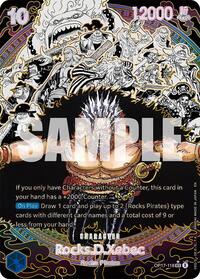 Rocks.D.XebecSuper Alternate Art | OP17 · OP17-118 | US$6,100 | US$3,750 |
| 5 |  Monkey.D.LuffySP | OP11 · OP05-119 | US$5,625 | US$6,998 |
| 6 |  Monkey.D.LuffyManga | PRB-01 · OP05-119 | US$5,000 | US$5,000 |
| 7 |  Monkey.D.LuffySP | EB02 · OP05-060 | US$5,000 | US$4,999 |
| 8 |  SaboRed Super Alternate Art | OP13 · OP13-120 | US$4,800 | US$4,300 |
| 9 |  ShanksParallel · Manga · Alternate Art | OP01 · OP01-120 | US$3,999 | US$2,459 |
| 10 |  Tony Tony.ChopperManga | PRB-01 · EB01-006 | US$3,000 | US$3,000 |
Monkey.D.Luffy (SP · Gold) from A Fist of Divine Speed tops the list at US$13,000. The full ranking is in the most expensive One Piece cards, rebuilt from our price data every time the page loads.
Where fakes come from, and where they don't
| Where you buy | Risk | Why |
|---|---|---|
| A card store opening its own product | Very low | The store pulled the card from a sealed pack. The only risk is a store that also buys collections without checking. |
| TCGplayer and the stores we compare | Low | Sellers are accountable, refunds are easy, and the price data below makes a too-cheap listing stand out. |
| eBay | Low to medium | Buyer protection covers counterfeits, but check seller feedback, photos of the actual card and the price against the table above. |
| Social media, marketplace apps, cash sales | High | No protection, stock photos, and most of the reported fakes. Do every check in person before paying. |
| Bulk lots and 'mystery' bundles | High | The cheapest way to move fakes is to hide a few among real commons. |
OP Compare tracks 417 stores and shows only their own listings, so a price on a card page is a real store's price for a card it is accountable for. The stores page lists them by market.
Graded cards and fake slabs
A card in a PSA, BGS, CGC or SGC slab has already been checked for authenticity, which is one reason expensive One Piece cards trade graded. But the slabs are faked too, usually around a fake card. Check the certification number on the grader's own site: it should show the same card, the same grade and, where the grader publishes one, a matching photo. A slab with a scratched-off label, a number that returns a different card, or a grading company you cannot find is the fake you were trying to avoid.
OP Compare's comparison covers raw cards; graded listings appear only in the eBay panel on a card's page, labelled as such, and are never counted as a store.
If you have already bought one
- Photograph the checks: the back beside a real card, the light test, the font. That is the evidence a refund claim needs.
- Claim within the window. eBay and PayPal treat a counterfeit as “significantly not as described”; marketplace apps and stores have their own windows, usually 14 to 30 days.
- Do not resell it, even marked as a proxy. Proxies get resold without the mark.
- Next time, buy from a store and compare the price first. Every card page on OP Compare ranks every in-stock listing by price, so a chase card at a real price is one click, and the deal finder shows which stores are under market right now.
 Rocks.D.Xebec · Super Alternate ArtUS$3,750.00
 Shanks · Parallel · Manga · Alternate ArtUS$2,500.00Free postage
 Tony Tony.Chopper · MangaUS$3,000.00
 Roronoa Zoro · Alternate Art · MangaUS$2,850.00Free postage
- Monkey.D.Luffy · SP · GoldFind on eBay →
- Boa Hancock · SPFind on eBay →
Affiliate link: as an eBay Partner Network affiliate, OP Compare earns from qualifying purchases — at no extra cost to you.
Top One Piece cards on TCGplayer
Market prices from thousands of US sellers
- US$13,000
Monkey.D.Luffy · SP · Gold
TCGplayer market
- US$6,970
Boa Hancock · SP
TCGplayer market
- US$6,836
Tony Tony.Chopper · SP
TCGplayer market
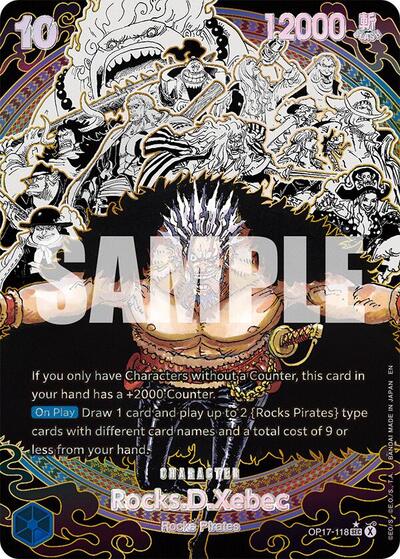 US$6,100
Rocks.D.Xebec · Super Alternate Art
TCGplayer market
 US$5,625
Monkey.D.Luffy · SP
TCGplayer market
 US$5,000
Monkey.D.Luffy · Manga
TCGplayer market
 US$5,000
Monkey.D.Luffy · SP
TCGplayer market
 US$4,800
Sabo · Red Super Alternate Art
TCGplayer market
 US$3,999
Shanks · Parallel · Manga · Alternate Art
TCGplayer market
 US$3,000
Tony Tony.Chopper · Manga
TCGplayer market
 US$3,000
Tony Tony.Chopper · Alternate Art · Manga
TCGplayer market
 US$2,500
Roronoa Zoro · Alternate Art · Manga
TCGplayer market
- Shop TCGplayer →Every listing, sorted by price
Affiliate link: OP Compare earns a commission from qualifying TCGplayer purchases — at no extra cost to you.
Frequently asked questions
What is the quickest way to spot a fake One Piece card?
Put it next to a common from the same set and compare the back. Counterfeits almost always get the card back wrong: the blue is too dark or too purple, the Bandai logo and the small text are soft, and the border is thinner or thicker than the real card's. The light test (a phone torch behind the card) is the second check: a real card's black core lets almost no light through.
Are fake One Piece cards common?
On marketplaces and at the cheap end of social media sales, yes, especially for Manga rares, SP cards and alternate-art Leaders. At a store that opens its own product, almost never. The counterfeits are of the cards worth faking, which is why the chase cards get checked and the commons do not.
Can a fake card be graded?
Grading companies reject counterfeits, so a card already in a PSA, BGS or CGC slab has passed that check. Check the slab's certification number on the grader's own site, because fake slabs exist too.
Is a card with a different font or a misprint always fake?
No. Bandai's own print runs have real misprints and miscuts, and the English, Japanese and Chinese versions use different fonts and layouts. A card is suspect when it differs from a known-real copy of the same printing and language, not when it differs from another language's version.
What should I do if a card I bought is fake?
Ask for a refund with photos. eBay's and PayPal's buyer protections treat a counterfeit as 'not as described'; a store will usually refund without argument. Do not resell it, even as a proxy with a disclosure, because it will be resold again without one.
- Rocks.D.Xebec · Super Alternate ArtUS$3,750.00
 Shanks · MangaUS$1,400.00Free postage
 Monkey.D.Luffy · Super Leader Alternate ArtUS$1,200.00Free postage
 Edward.Newgate · MangaUS$839.99
 Kaido · MangaUS$750.00
 Charlotte Linlin · MangaUS$613.30Free postage
Affiliate link: as an eBay Partner Network affiliate, OP Compare earns from qualifying purchases — at no extra cost to you.
Shop the cards in this post
Prices in USD- Monkey.D.LuffySP · Gold · OP11 · OP05-119US$18,5002 US storesSearch eBay →
- Boa HancockSP · EB02 · OP07-038US$5,4991 US storeSearch eBay →
- Tony Tony.ChopperSP · EB02 · OP08-001US$2,8441 US storeSearch eBay →
- Rocks.D.XebecSuper Alternate Art · OP17 · OP17-118US$3,7503 US storesSearch eBay →
- Monkey.D.LuffySP · OP11 · OP05-119US$6,9981 US storeSearch eBay →
- Monkey.D.LuffyManga · PRB-01 · OP05-119US$5,0003 US storesSearch eBay →
Prices are the cheapest in-stock listing we track in the United States (item price, before postage), or TCGplayer's market price (≈) where no US store has it. The eBay buttons are paid links that search eBay; we may earn a commission at no cost to you. Check seller ratings before buying.
Compare other TCGs
- Riftbound card prices on RiftCompare
- Pokémon TCG prices on DexCompare
- Magic: The Gathering sealed prices on MTG Compare
- Gundam Card Game prices on Gundam Compare
- Disney Lorcana card prices on Lorcana Compare
- Yu-Gi-Oh! card prices on YGO Compare
- Cyberpunk TCG card prices on Cyberpunk Compare